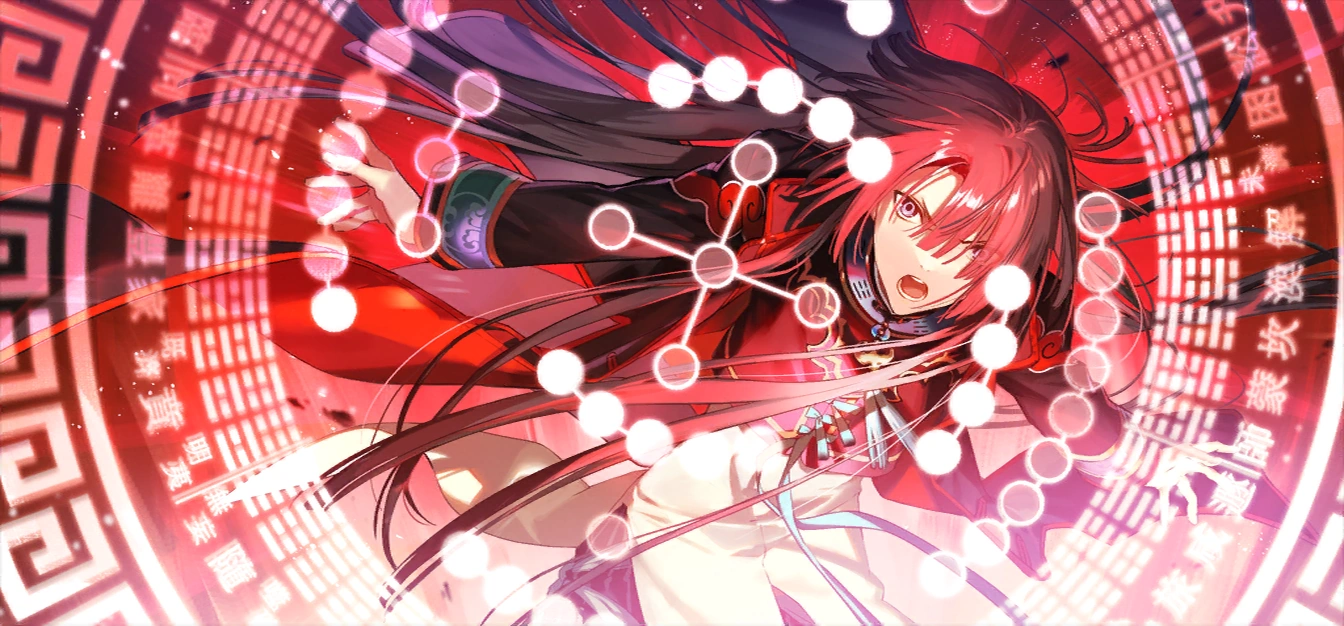

Taigong Wang casting a Spell with his Thought Key.
Thought Magecraft (思想魔術, Shisō Majutsu?, also translated as "Philosophy Magecraft" and "Ideological Magecraft"), also called FangshuWP (方術, Taoist Arts?) and Xian Arts (仙術, Senjutsu?), is the form of magecraft practiced across mainland continental Asia, from China to the Middle East. Thought Magecraft is heavily influenced by TaoismWP.[1]
Thought Magecraft is just as wide and varied as Western Magecraft (西洋魔術, Seiyō Majutsu?);[2] the only things they share in common are the barest fundamentals and the use of Magic Circuits.[3]
Mechanics
Instead of using Magic Crests like in Western Magcraft, Thought Magecraft uses Thought Keys (思想鍵紋, Shisō Kagimon?).[4][5] They are the Xian's equivalent to Magic Crests and are passed down from teacher to student. The magecraft inscribed in the Keys are like marks painted in a bowl. The "Bowl" remains unchanged but the spells that can be used depends on the Key the user is given. While some can cast spells powerful enough to affect the World, the World can also retaliate if those are used. Inheriting a Thought Key means constantly taking influence from the “bowl”. One who inherits a top-class Thought Key and succeeds at fully drawing out its abilities is called a Tianxian and is past halfway through a process of fusing with the world. Those who managed to reach this point gain a level of influence somewhat similar to that of a Servant, but at the same time, struggle to maintain the self-identity necessary to brandish their powers.[5]
Thought Magecraft uses the Thought Foundation (思想盤, Shisō-ban?), which is essentially a simulation of an artificial Root. It is also called The Disc (盤, Ban?).[6] The Thought Foundation was created by the Ten Officials of the Summit Court, Xian from the Age of Gods. It took all of them working together as a group to build and is not replicable in modern times. Instead of connecting to the Root using the Gods as a relay, as magecraft was done by civilizations in the Age of Gods, the Xian created their magecraft system by building a Supergiant Mystic Code that is fused with the planet. That is the Thought Foundation.[7]
Most magecraft in the West is activated through the Magecraft Foundations carved in the Ley Lines and the spell's Magic Formula. But for magi using Thought Magecraft, what makes the magecraft work is the spell's Magic Formula and the Thought Foundation that they constructed and now share and maintain among themselves. It's like a library membership; the restrictions on their Magic Formulae and Thought Keys changes what books they can borrow, but everyone is still using the same Thought Foundation.[7]
There are also the Privileged Domains (特権領域, Tokken Ryōiki?, localized as "Protected Memory Space") within the Thought Foundation, which can only be accessed by special Thought Keys, such as the Thought Key of Taigong Wang who is from the 1000s BC.[8] Thought Keys leading back to the founders enable access to the Privileged Domains.[1]
Despite being called a "Disc", it is somewhat like a path and somewhat like a particle accelerator. It’s the cloud computing of thoughts humans can’t fully utilize, but this Disc does more than only collect the thoughts, it accelerates the thoughts nonstop, and continues to expand to this day… or it’s watching the fantasy where it continued to expand. The changes to magecraft at the end of the Age of Gods reached everyone equally, including Thought Magecraft, and that brought about major losses and minor benefits.[6]
It's possible to access the Thought Foundation without a Thought Key, but the usable magecraft is limited to the basic spells (though it is still possible to achieve advanced spells by compiling basic spells together). The access rights provided by the Thought Key are to a sort of Privileged Domain. This is similar to how the spells contained in a Magic Crest are, almost without exception, secret arts directly connected to one's family.[5]
The goal of Thought Magecraft is not to reach the Root, but rather to make the Thought Foundation match the Root's accuracy, although that act is akin to attempting to fix a long-broken plate without having all the missing parts.[6]
Thought Magecraft is just as wide and varied as Western Magecraft, it even includes its own form of Alchemy. The Shenxian Laozi cast Sun Wukong into his Trigram Furnace for 49 days after the Monkey King ate the peaches and elixir of immortality which was distilled through Alchemy. While it's commonly viewed as a punishment, from a magus perspective that tale describes the process in which the divine elixir of immortality is assimilated into Wukong, and by using that myth as a basis other non-Thought Magecraft Alchemists were able to form their own rituals of it.[9]
The Spiral Manor in China is an organization of Thought Magecraft users. Their Thought Magecraft is fundamentally incompatible with the Western Magecraft of the Clock Tower, and the two have a feigned nonaggression pact.[10]
Practitioners
- Summit Court
- Shenxian
- Laozi
- Taigong Wang
- Yuanshi Tianzun
- Spiral Manor
- Bai Ruolong
- Limbo
- Lostbelt Qin Shi Huang
- Mori Souiken (Studied various magecrafts in China.)[11]
- Nezha (Taoist Techniques)
- Xu Fu
- Zhang Jue
- Zhuge Liang
References
- ↑ 1.0 1.1
[] The Adventures of Lord El-Melloi II First material - Terminology: KeyPoint 04: Philosophy Magecraft, p.005 Philosophy Magecraft
For the Clock Tower in the Occident, there is the Luo-Xuan Guan in the Orient. Philosophy Magecraft is the main magecraft employed by this Luo-Xuan Guan, spread from Asia to the Middle East.
Unlike the Clock Tower's Western Magecraft, this one doesn't employ Magecraft Foundations. Instead, it's utilized by connection to a giant Greater Mystic Code fused with planet Earth, the Philosophy Foundation - sort of a pseudo-Root.
The currently distributed Philosophy Keys enable access to restricted territories of this Philosophy Foundation.
Philosophy Keys are passed down from teacher to student, and inheriting a Philosophy Key essentially means shouldering a part of the world.
It's worth special mention that the Philosophy Key leading back to the founders are said to enable connection the Privileged Domains.思想魔術
―西洋に時計塔あらば、東洋に螺旋館あり。主にアジアから中東にかけて広がった、この螺旋館で主流となる魔術。
時計塔の西洋魔術と異なり、魔術基盤ではなく、地球と融合した巨大礼装・思相平ある種の擬似根源と繋がる事によって行使される。
現代に伝わる思鍵紋は、この思想で制限されている領域への接続を可能とする。
思想鍵紋は師から弟子へ引き継がれるものであり、思想鍵を引き継ぐということは、すなわち世界の一部を背負うことに等しい。
とりわけ、始祖に連なるような思想鍵紋は、 特権領域への接続を可能にするという。 - ↑ The Adventures of Lord El-Melloi II Volume 2: The Devil of the Wandering Sea (Upper) - Chapter 2
- ↑ The Adventures of Lord El-Melloi II Volume 1: The Man Who Devoured God - Prologue
- ↑ The Adventures of Lord El-Melloi II Volume 2: The Devil of the Wandering Sea (Upper) - Chapter 2 Part 4
- ↑ 5.0 5.1 5.2
[] TYPE-MOON BOOKS material -The Adventures of Lord El-Melloi II Glossary: Thought Key [Magecraft/Other], p.023-024 Thought Key [Magecraft/Other]
Thought Magecraft’s version of a Magic Crest.
They are access rights to a vessel—the Thought Foundation.
They are passed down from teacher to student, and unlike Magic Crests, aren’t restricted to families and bloodlines. The magecraft inscribed in this Key is like marks painted in a bowl. The bowl remains unchanged but is observed differently depending on what’s painted on it. Long story short, the whole world can be deceived by this. Just watch out for when the world retaliates.
However, inheriting a Key means constantly taking influence from the “bowl”. One who inherits a top-class Key and succeeds at fully drawing out its abilities is called a Tianxian and is past halfway through a process of fusing with the world. Those who managed to reach this point gain a level of influence somewhat similar to that of a Ghost Liner, but at the same time, struggle to maintain the self-identity necessary to brandish their powers.
Side note: It’s possible to access the Thought Foundation without a Key, but the usable magecraft is limited to the basic spells (It’s still possible to achieve advanced spells by compiling basic spells together). The access rights provided by the Keys are to a form of privileged domain. This is similar to how the spells contained in a Magic Crest are, almost without exception, secret arts directly connected to one’s family.思想鍵紋(しそうけんもん)【魔術/その他】
思想魔術における魔術刻印。
これは「器」――思想盤に対するアクセス権である。
師から弟子に受け継がれるものであり、魔術刻印と違って、血や家系に固定されない。この鍵紋に刻まれた魔術は、たとえば器に絵付けするようなものだ。器そのものは変わらないが、その絵付けによって観測は変わってしまう。つまるところ、世界をまるごと騙してしまうことになる。しっぺがえしは世界から食らうことになるのでご注意。
ただし、鍵紋を引き継いだからには、常に「器」から影響を受けることとなる。
最上位の鍵紋を引き継ぎ、その能力を完全に引き出すに至った者はいわゆる天仙であり、半ば世界と融合しつつある状態となる。ここまで至ったものはある意味境界記録帯(ゴーストライナー)にも比肩する影響力を持つことになるが、同時にその力を振るうだけの自我を保つことは難しくなる。
なお鍵紋がなくても、思想盤へのアクセスは可能だが、使用可能な魔術は基本的な術式に限定される(基本を積み重ねて高度な術式に至ること自体は可能)。鍵紋によるアクセス権はある種の特殊領域へのものだ。これは魔術刻印による術式が、ほぼ例外なく家門の秘奥に直結していることと似ている。 - ↑ 6.0 6.1 6.2
[] TYPE-MOON BOOKS material -The Adventures of Lord El-Melloi II Glossary: Thought Foundation [Mystic Code], p.024 Thought Foundation [Mystic Code]
The concept which composes the crux of Thought Magecraft. Called “the Disc” for short.
It’s an ultra-giant Mystic Code fused with Earth, and can also be considered the simulation of an artificial deity, or in a sense, an artificial Root. Users of Though Magecraft are connected to the Thought Foundation from beginning to end and use it as the medium to activate their magecraft.
Therefore, the goal in Thought Magecraft is not to reach the Root, but to make this Disc reach the Root’s level of accuracy. Although that act is akin to attempting to fix a long broken plate without having all the missing parts…
Now, despite the name “Disc,” it is somewhat like a path and somewhat like one of those particle accelerators from modern science. It’s the cloud computing of thoughts humans can’t fully utilize, but this Disc does more than only collect the thoughts, it accelerates the thoughts nonstop, and continues to expand to this day… or it’s watching the fantasy where it continued to expand (The changes to magecraft at the end of the Age of Gods reached everyone equally, including Thought Magecraft, and that brought about major losses and minor benefits).思想盤【礼装】
思想魔術の根幹をなす概念。単に、「盤」とも呼ばれる。
地球と融合した超巨大礼装であり、擬似的な人工神性、ある意味で人工根源と言ってもよい。思想魔術の使い手は、余さずこの思想盤とつながっており、これを介することによって魔術を発動する。
ゆえに、思想魔術は根源に至るのではなく、この盤の精度を根源に至らせることこそを目的とする。もっとも、それははるか昔に砕けた皿を、足りないパーツのまま修復するような行為なのだが……。
なお、盤と表記しているが、ある意味で「道」であり、ある意味では現代科学における「加速器」である。人間の使い切れていない思考を使ったクラウドコンピューティングであるが、この盤はそうした思考を蓄積するだけではなく、常に加速し続け、現代においても発展を遂げ続けている……あるいは発展している、という幻想を見ている(神代の終了による魔術の変化は、思想魔術にも平等に訪れたが、これは多大な喪失と、わずかな恩恵をもたらしたのである)。 - ↑ 7.0 7.1 The Adventures of Lord El-Melloi II Volume 3: The Devil of the Wandering Sea (Lower) - Chapter 3
- ↑ Fate/Grand Order - Taigong Wang's profile translated by ComunCoutinho
- ↑ The Adventures of Lord El-Melloi II Volume 5: Legacy of the Alchemist (Lower) - Chapter 3
- ↑
[] Fate/side material - Encyclopedia: The Mage's Association [Organization name], p.073 [T] The Mage's Association [Organization name]
An organization created to protect those who seek to learn sorcery, regardless of nationality or field of study. (On paper, anyway.)
Their mission is the management, concealment, and advancement of sorcery.
In order to protect themselves from that which would threaten them (be it the Church, rival organizations of magi, or the monstrosities that punish humans who break taboos), they accumulated military might.
In order to further the advancement (degeneration) of sorcery, they built research facilities.
And, in order to deter crimes committed with sorcery, they created laws.
Their headquarters is located in London, and goes by the unofficial name of "The Clock Tower".
It seems that in the beginning the Association was divided into three great branches, including the original associations that predate the Clock Tower. That is, the "Giant's Pit" of Egypt, and a cluster of associations based in northern Europe called the "Sea of Estray". However, ever since the Clock Tower became the headquarters, mingling between the branches has been on the decline.
Also, they are fundamentally incompatible with the sorcery foundation of the Middle East and the ideological sorcery of mainland China, and the three groups are currently feigning nonaggression.魔術協会【組織名】
国籍・ジャンルを問わず、魔術を学ぶ者たちによって作られた自衛団体。(無論、名目上ではある)
魔術を管理し、隠匿し、その発展を使命とする。
自らを脅かすモノたち(教会、自分たち以外の魔術団体、禁忌に触れる人間を罚する怪異)から身を守る為に武力を持ち、
魔術の更なる発展(衰退ともいう)の為、研究機関を持ち、魔術による犯罪を抑止する為の法律を敷く。
本部はイギリスのロンドンにあり、“時計塔”の異名を持つ。
始まりは三大の部門に分かれていたらしく、エジプトの“巨人の穴仓”,北欧に根を張る複合協会“访律海”と呼ばれる原協会もあるが、時計塔が本部になってからは交流が廃れる一方だとか。
また、中东圏の魔術基盤、大陸の思想魔術とは相容れず、互いに不可侵を装っている。 - ↑ Fate/Samurai Remnant - Logbook: Biographies